North, on the Twelfth
Grouse season opens on the Twelfth of August, and it has done so since the Game Act of 1831 settled the matter. Red grouse cannot be farmed or found anywhere outside the heather moorland of the British Isles...
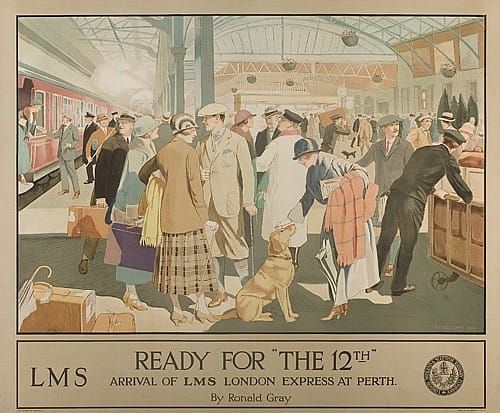
Grouse season opens on the Twelfth of August, and it has done so since the Game Act of 1831 settled the matter. Red grouse cannot be farmed or found anywhere outside the heather moorland of the British Isles, which means the sport can only ever happen in a handful of specific places, on this one date, and not a day earlier, dressed, as we've covered before, rather specifically for the part. That single fixed point in the calendar shaped a great deal more than the shooting itself. For well over a century, it also shaped how an entire class of Londoners travelled, packed, and planned their summer.
The London, Midland and Scottish Railway understood the opportunity well enough to build a service around it. Passengers bound for the grouse moors needed to arrive in Scotland with a day or two in hand before the season opened, time enough to settle guns, dogs, and households before the early start on the Twelfth itself. A 1924 poster advertising the LMS route to Perth shows something of what that arrival looked like: a platform crowded with tweed and trunks, dogs threading between the luggage, everyone converging on the same city at more or less the same hour. It is not a romanticised scene so much as a fairly literal one. This is what a railway company thought would make people want to buy a ticket, and evidently it worked.
The Precision the Season Demanded
What made this particular journey different from an ordinary summer holiday was its total lack of flexibility. Most Victorian and Edwardian travel had some give in it, a week either way rarely mattered for a seaside stay or a visit to relatives. The grouse season allowed no such margin. The opening days were, by common agreement among those who shot, the best of the entire five months, since the birds were at their most plentiful and least wary before weeks of shooting had thinned and educated them.
This turned the trip north into rather more of a logistical exercise than a holiday. Guns needed to travel cased and ready, not requiring last-minute attention on arrival. Dogs needed to make the journey calmly enough to be fit for work within a day or two of stepping off the train, no small thing after hours in a carriage. Luggage had to be sorted quickly at Perth so that onward travel to the estate itself, often still some distance by road, could happen before the light failed. None of this looked particularly glamorous up close. It photographed a great deal better than it felt to organise.
Why the Railway Mattered So Much
Before the railways reached this far north in any serious way, the grouse moors were simply inaccessible to most of London society within any useful timeframe. The journey by road took considerably longer, which put a real ceiling on how many people could reasonably make the trip for a single season's shooting. The railway collapsed that journey to a single overnight sleeper, and in doing so, turned what had been a genuinely rare undertaking into something a much wider slice of wealthy London could plan around each August.
This is worth remembering when looking at a poster like the LMS one, because it is easy to read these images purely as nostalgia, tweed and dogs and a bygone kind of elegance, without noticing what they were actually advertising. They were selling speed and reliability, the promise that a passenger could leave London on one evening and be ready for the season by the following morning. That was the genuine innovation being marketed, however picturesque the illustration made it look.
What Has Actually Changed
Motorcars eventually took over from the sleeper carriages, and the calculation shifted again after that, a shorter drive, then eventually a flight. What once meant an entire household relocating for weeks now more often means a lighter trip, planned around a long weekend rather than a season.
The Twelfth itself has not moved. Arrive in time and the shooting is at its best. Arrive late and it isn't. The trains no longer run the way they did in 1924, and nobody could quite recreate that crowded platform today, but the idea behind it, that this particular date still doesn't much care how anyone gets there, hasn't gone anywhere either.
Comments ()