How the Enclosure Tells on You by Four O'clock
By mid-afternoon at Henley, a jacket that has given up is not hard to spot. The shoulders develop a faint shine where the sun has been sitting on them all day. The collar softens and loses its roll.

By mid-afternoon at Henley, a jacket that has given up is not hard to spot. The shoulders develop a faint shine where the sun has been sitting on them all day. The collar softens and loses its roll. The cloth stops moving with the wearer and starts clinging instead, particularly across the back after a stretch on one's feet. None of this is dramatic. It simply looks tired, in the way a jacket ought not to by six o'clock.
Worsted and flannel are usually to blame, and it is worth being clear that neither belongs at Henley. Worsted is wool spun into a smooth, tightly woven cloth, built for a crisp line and a long working day indoors. Flannel is wool with a brushed finish, softer to the eye, warmer to wear. Both were made with a London winter in mind, not a riverbank in July, and both will make their objections known by mid-afternoon.
Wool still has a place, provided it is the right sort. A high-twist wool, sometimes sold as fresco, is spun harder and woven more openly than an ordinary suiting, which lets air pass through the cloth rather than sitting trapped against the skin. It keeps a jacket's shape without keeping its heat, which is really the whole trick. Fresco is a genuine trademarked cloth, woven since 1907 by Huddersfield Fine Worsteds, and it turns up regularly in the summer bunches of Savile Row tailors.
Linen is the other sensible route, though it asks something different of the wearer. It creases within the hour and goes on creasing, and that is not a fault to manage but simply how linen behaves. A linen jacket that looks slightly lived in by four o'clock is doing exactly what it should. An Irish linen in a pale stone or faded blue, the sort of thing associated with a certain unhurried Anglo-Italian dressing, wears its creases as evidence of a day well spent rather than a day mishandled.
Cut matters as much as cloth. A softly shouldered, lightly canvassed jacket moves with the body rather than holding a shape the body no longer has by four o'clock. A heavily lined, town-built one, however handsome in the shop, tends to hold its crease a little too well once the sun has been on it, which is its own kind of tell.
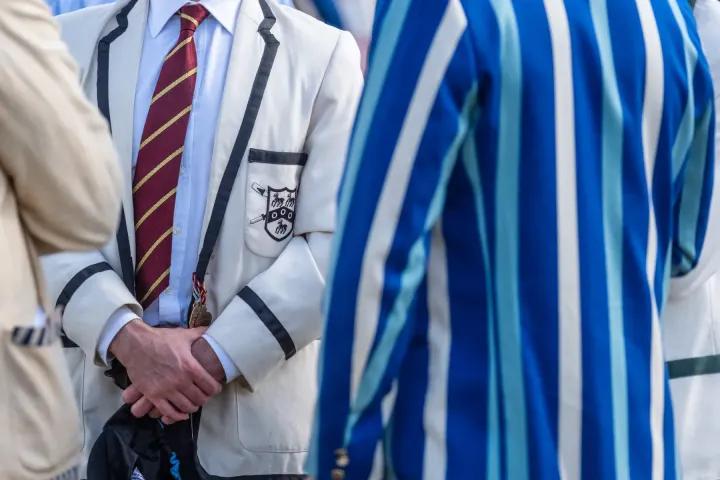
None of this applies to rowing blazers, whose cloth is fixed by club or college rather than choice. It is for everyone else, in suits and odd jackets, where the choice is entirely one's own.
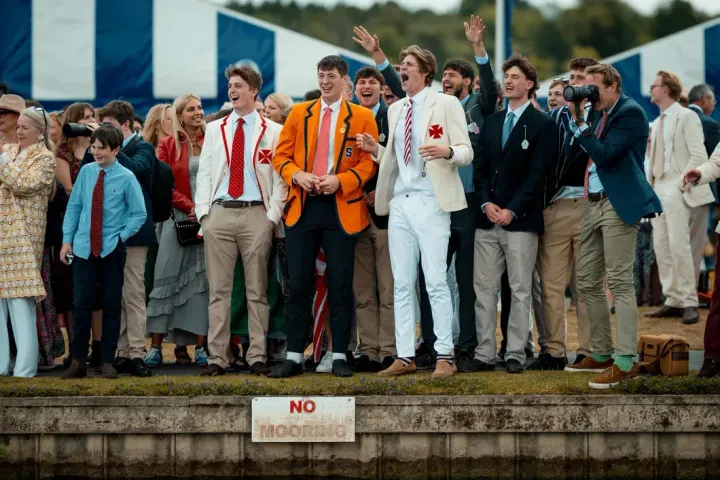
The look this all points towards is closer to an old garden party photograph than a City lunch: jacket open, nothing pressed too hard, a touch of ease that reads as unbothered rather than undone. That looseness is not an accident. It is what happens when the cloth has been chosen properly and left to get on with the day.

Comments ()