The Grey Partridge and What It Tells Us
The grey partridge belongs to a particular kind of English countryside – one that existed before intensive farming, before broad-spectrum pesticides, and before the landscape was asked to produce quite so much, quite so quickly.
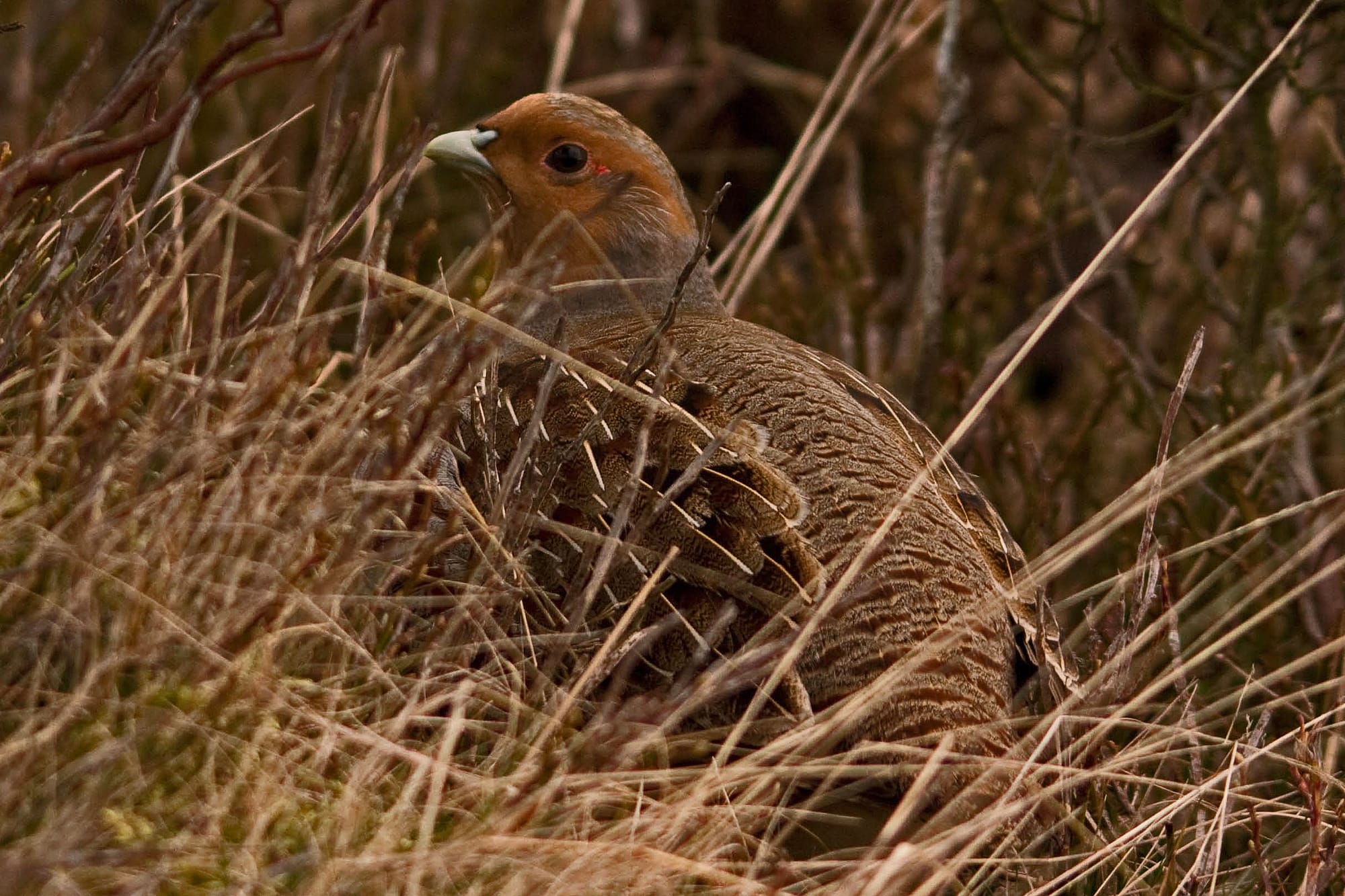
The grey partridge belongs to a particular kind of English countryside – one that existed before intensive farming, before broad-spectrum pesticides, and before the landscape was asked to produce quite so much, quite so quickly.
It is the bird that marked the opening of the shooting season on the first of September, when stubbles lay gold across the fields and coveys gathered at the margins. Between 1870 and 1930, two million grey partridge were shot annually in Britain without troubling the population in the slightest. They were simply everywhere.
Now they are not.
The Decline
The grey partridge has suffered a 94% decline since the 1980s. It has been on the UK Red List since 1996, and current estimates suggest somewhere between 37,000 and 43,000 breeding pairs remain across the country. For a bird that once defined lowland game shooting, these are sobering figures.
The reasons are well understood. Agricultural intensification from the 1950s onwards brought herbicides that removed the weedy field margins where partridge nested, and insecticides that decimated the beetle larvae, sawflies and leaf beetles on which partridge chicks depend during their first crucial weeks. Chick survival rates collapsed, and the population followed.
Predation increased as habitat contracted. Larger fields and faster machinery left fewer places to hide. The grey partridge, which had thrived in the mixed farming landscape of hedgerows, small fields and crop rotations, found itself in a countryside that no longer accommodated it.
Where They Remain
Grey partridge persist in two contexts: on estates that have made their conservation a priority, and in pockets of the country where older farming practices still hold. The Game & Wildlife Conservation Trust's Partridge Count Scheme shows an 81% increase on participating sites since 2000, which sounds encouraging until one realises these are the exceptions. Across the wider countryside, the decline continues.
The estates that manage successfully for grey partridge do so through a combination of habitat creation, reduced pesticide use, and predator control. They provide beetle banks, conservation headlands and wild bird seed mixtures. They leave margins unsprayed. They count their birds carefully and shoot only a sustainable surplus – no more than 30% of the autumn population in a good year, and often nothing at all.
This is not the grand-scale partridge shooting of the Victorian and Edwardian eras. It is careful, deliberate, and expensive. The grey partridge has become a barometer of conservation commitment rather than an abundant quarry species.
What Shooting Took, and What It Gives
The relationship between shooting and the grey partridge is more complex than it first appears. Historically, driven partridge shooting created the conditions for their abundance – comprehensive predator control, mixed farming, hedgerows and field margins all maintained for sport. The decline began when those practices stopped, not when shooting continued.
Today, irresponsible shooting can tip vulnerable populations into local extinction. Over-shooting, or the accidental shooting of grey partridge during red-legged partridge drives, damages populations that can ill afford it. But the estates where grey partridge numbers are actually recovering are shooting estates. They are the ones providing the habitat, controlling the predators, and monitoring the population carefully enough to know what can be sustainably harvested.
It is an uncomfortable truth for both sides of the conservation debate: the grey partridge's best chance of recovery lies with the people who intend, eventually, to shoot a small number of them.
Why It Matters
The grey partridge is an indicator species. Its presence suggests a landscape where insects thrive, where field margins remain, and where farming has left room for something other than maximum yield. Its absence tells the opposite story.
For those who care about the British countryside – whether or not they shoot – the grey partridge represents a kind of litmus test. Can we produce food and maintain biodiversity? Can traditional land management practices coexist with modern agriculture? Can a bird that was once ubiquitous be brought back from the edge?
The answers are not yet clear. What is clear is that the grey partridge will not recover by accident. It requires deliberate effort, knowledge, and a willingness to farm in ways that are no longer economically straightforward.
Some estates are doing this work quietly and without fanfare. The bird remains on the Red List, and the overall population continues to fall. But where commitment exists, grey partridge return. They are still there in the stubble on a September morning, still calling at dusk across the fields, still offering a glimpse of what the countryside was, and what it might be again.
--
Image: "Partridge Grey partridge Perdix Worlds End Wales 20/03/12" by Mick Sway is licensed under CC BY-ND 2.0. To view a copy of this license, visit https://creativecommons.org/licenses/by-nd/2.0/?ref=openverse.