The Boat Race: A Short History of Britain's Long Rivalry on the Thames
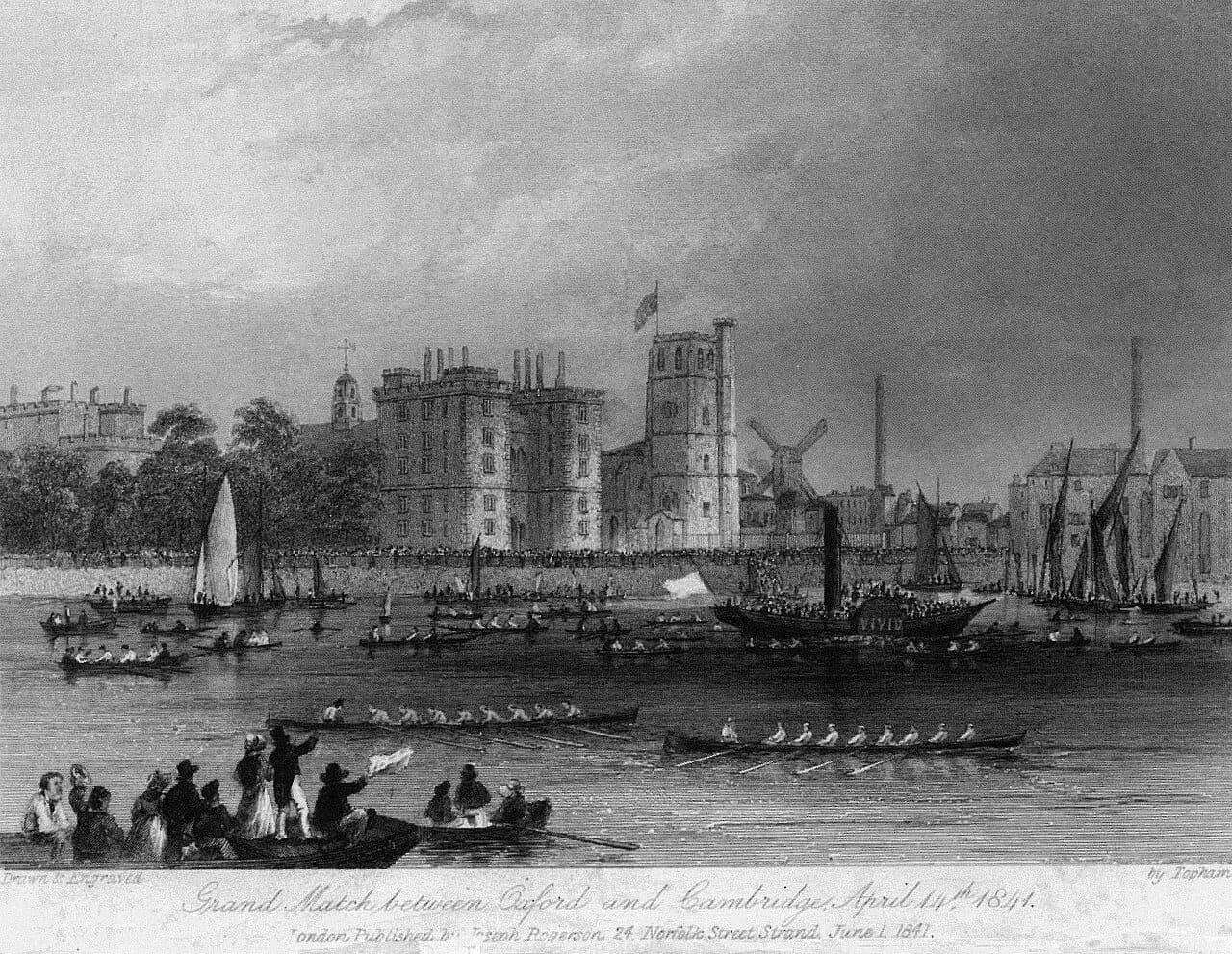
It began, as so many English traditions do, with two friends and a disagreement about where to hold the party. In 1829, Charles Merivale of St John's College, Cambridge, and his old school friend Charles Wordsworth of Christ Church, Oxford, arranged a race at Henley-on-Thames between their respective university boat clubs. Oxford won. The loser demanded a rematch, and nearly two centuries later the arrangement has never quite been resolved.
What followed from that first afternoon on the water at Henley is one of the more improbable success stories in British sport: a race between amateurs, held on a tidal stretch of the Thames in west London, watched by a quarter of a million people on the banks and millions more at home, and capable still of producing the kind of drama that makes grown men shout at bridges.
Finding the Course
The race did not settle immediately into its current form. The first running on the Putney to Mortlake course came in 1845, by which point the earlier Westminster stretch had grown too crowded. It became an annual fixture in 1856, and has run every year since, excepting the two World Wars and the disruption of 2020.
The Championship Course covers 4.25 miles of tidal Thames, from Putney Bridge to just before Chiswick Bridge, passing under Hammersmith Bridge and Barnes Bridge along the way. The S-shape of the course matters: the bends favour different stations at different tides, which is why the presidents toss a coin before the race -- an 1829 gold sovereign -- for the right to choose their side of the river. It is one of those small details that repays knowing.
The Nature of the Thing
The Boat Race resists easy categorisation. It is not Henley, where the enclosures and the dress code and the strawberries form as much of the occasion as the racing itself.Nor is it a mass-participation spectacle in the vein of the London Marathon, where the crowd cheers everyone equally. It is something older and stranger: a contest between two institutions that most people on the towpath have no particular connection to, and yet everybody chooses a side.
The crews are a mix of Olympic veterans, international rowers on graduate programmes, and students who learned to row in their first Michaelmas term. What unites them is that they are, by definition, amateurs -- full-time students training at the limit of what elite sport demands. The results are occasionally eccentric. In 1912, run in exceptional weather, both crews sank. Oxford, having taken an early lead, began shipping water after Hammersmith Bridge and made for the bank; Cambridge, by then also in difficulty, did the same near the Harrods Depository. The race was abandoned.
The Women's Race
The Women's Boat Race was first held in 1927, fifty years before women's rowing appeared at the Olympic Games. For much of its history it ran separately from the men's event and on different water: alternating between the Isis at Oxford, the Cam at Cambridge, and later Henley. It was not until 2015 that both races were brought together on the Championship Course on the same day -- a change that felt long overdue, and that has made the occasion considerably more compelling as a result.
The Women's Race now carries its own weight in the fixture. Cambridge Women have won every race since 2017. Oxford arrive on Saturday with eight consecutive defeats behind them.
A Party by the River
Part of what makes the Boat Race unusual among major British sporting occasions is that it costs nothing to attend. The towpath from Putney to Mortlake is public, the river is public, and the race simply happens on it. At its mid-Victorian peak it was something of a Cockney festival, every Londoner descending on the river on the chosen April morning. The demographics have shifted since, but the essential quality of the day has not: it remains a rare occasion when the city turns out for something that asks nothing in return.
The pubs help. The Duke's Head at Putney has watched the start for well over a century. The Dove and the Blue Anchor sit along the Hammersmith stretch. The Ship at Mortlake has been on the finishing line since 1845, which gives it a reasonable claim to having seen more Boat Race finishes than any other establishment in England.
2026 and the State of Play
Saturday's race will be the 171st Men's and the 80th Women's, and it arrives at a moment of pronounced Cambridge dominance. Cambridge have won six of the last seven men's races, with the margins growing each year since 2023. Oxford's most recent men's victory was in 2022; on the women's side, the streak is longer still.
Both men's Blue Boats will be led by Frenchmen this year: Noam Mouelle for Cambridge and Tobias Bernard for Oxford, the first time in the race's history that the two coxes have shared a nationality. Oxford Women are captained by Heidi Long, Olympic bronze medallist from Paris 2024, who will be hoping that what she could not quite settle in France she can resolve on the Thames instead.
The 2026 race is also the first to be broadcast on Channel 4, following the BBC's long tenure with the event. Some traditions accommodate change without great difficulty. The Thames, for its part, will be indifferent.
Image: The 1841 Oxford-Cambridge Boat Race - engraving - 1841. "Grand Match between Oxford and Cambridge, April 14th 1841. Drawn & Engraved by Topham." published by "Joseph Rogerson, 24 Norfolk Street Strand, June 1, 1841"